
"For the first time, we'll see the same comet before and after its closest approach to the Sun," he said yesterday at a press conference, Joe Veverka, senior researcher of the mission of NASA's Stardust-NEXT.
In 2005, NASA's Deep Impact probe has photographed Comet Tempel-1 before its perihelion passage.
Next February 14 (Valentine), with another NASA spacecraft, Stardust-Next, we will close the second part of the investigation looking at how the comet has been changed after the perihelion.
"The close encounters with the Sun is never healthy for a comet," says Veverka. The strength of the sun's heat evaporates the ice in the comet's nucleus, causing jets of dust and gas. The loss of cyclic materials, eventually leading to his death. In practice is consumed in each step. "
The researchers believe that the modifications of the comet will not occur evenly across the surface of a comet, but until hours lacked a way to document where, exactly, they occur.
Stardust NEXT will take images of some of the same surface areas already photographed by Deep Impact 6 years ago and reveal how these areas have changed and the way in which the material is lost.
"Deep Impact gave us interesting pictures of Tempel-1 and we have seen strange and unusual things that we would like to investigate more closely." say the researchers.
The characteristics that are more interested to see are, for starters, sides of the comet's surface that are laminated together "like pancakes."
"The Earth has layers, but the effect of atmospheric stratification on a comet was a surprise - and a mystery, "says Veverka.

" One hypothesis is that two proto cometary bodies may collide at low speed and blend together to form something like a stack of pancakes, "said Pete Shultz, team Stardust-NEXT.
E 'possible? The data obtained from Stardust-NEXT will provide clues and possibly reveal what he has created the" pancakes comet (comet pancakes ").

Stardust-NEXT rivelerà come l'altopiano è cambiato, aiutando il team a determinarne l'origine. Qualunque sia la loro origine, l'altopiano e la stratificazione dimostrano che le comete hanno una storia geologica molto più complicata di quanto si pensasse.
"Tempel-1 non è solo un ammasso confuso di polveri e rocce spaziali. E' storia", dice Shultz.
E' una storia che la NASA ha costruito nel corso degli anni dall'incontro del 2005 di Deep Impact con la quale sganciò un proiettile verso la cometa per verificarne le "reazioni", gli effetti.
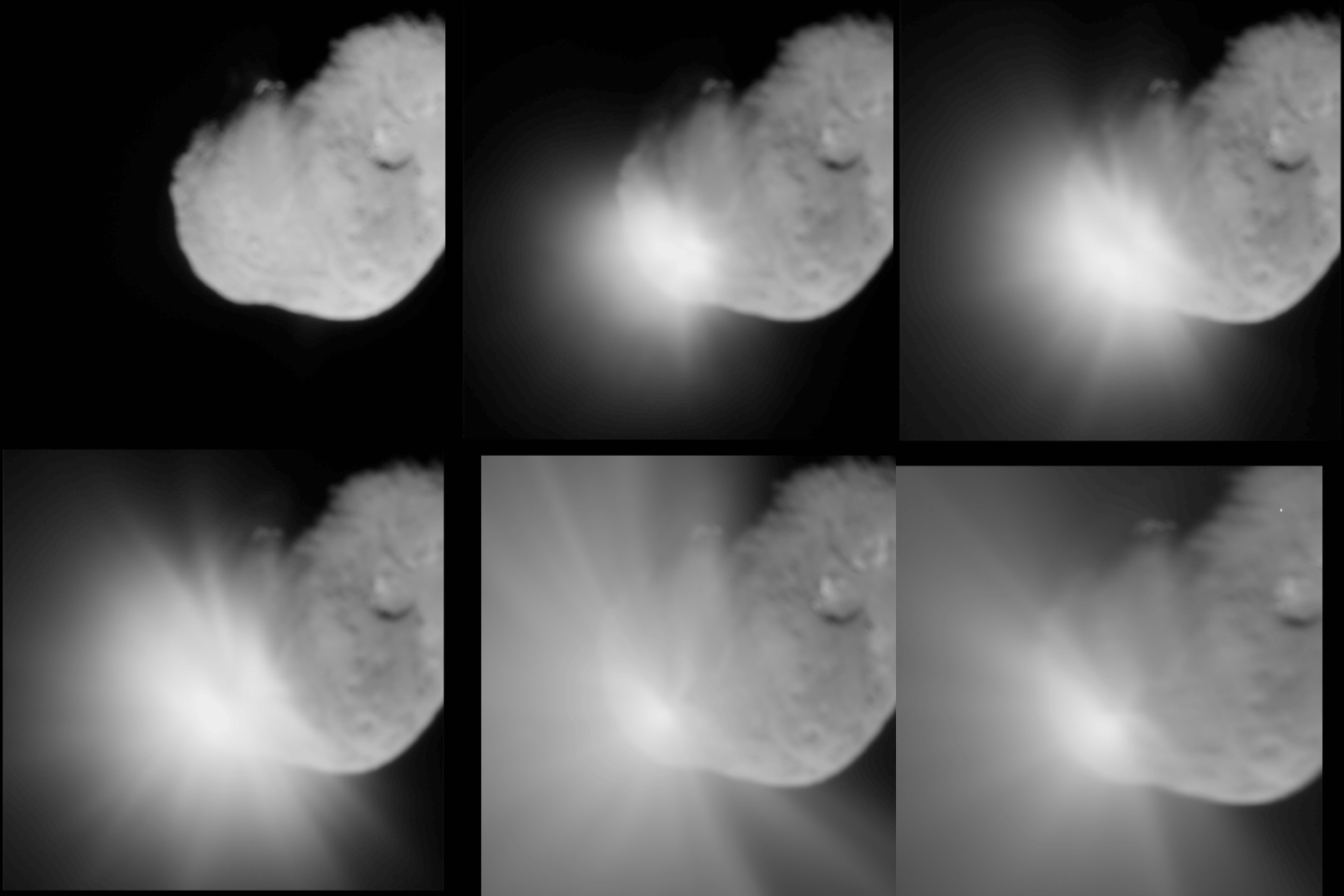
Sorprendendo gli scienziati della missione, l'impatto scavò così tanto materiale che non fu can observe the crater. The cameras were not able to see through the huge cloud of dust that the blast had created. Stardust NEXT
could finally provide images that show the long-awaited outcome of the impact.
"The dust will be deposited, so if the right side of the comet in front of us, we can see and know the size of the crater," says Veverka. "This could finally answer some basic questions. For example, the surface of a comet is hard or soft?"
In a future mission, a spacecraft will land on a comet and collect samples for analysis. To design a form suitable for landing, the researchers need to know what kind of surface should land. They must also know what tools to send to be able to collect samples of surface and drill also to test the latter possibility.
How Deep Impact, the spacecraft Stardust-next has already had a brilliant career.
Launched in 1999, came close to the comet Wild-2 in 2004, enough to take pictures of its surface full of activities and also to collect the dust particles from the atmosphere of the comet and one of the key findings of the sample was the discovery of amino acids that is a basic element for the structuring of life.
"We could leave this old to rest veicolo spaziale adagiato su questi allori, lasciandolo in orbita per sempre intorno al Sole ma invece lo stiamo nuovamente utilizzando per fare scienza di primordine sulle comete"", dice Veverka.
Per quanto riguarda la Tempel-1, dopo l'incontro con Stardust-NEXT... un Sole "affamato" l'attende per rosicchiarne un'altra razione.
Attendiamo il 14 febbraio e speriamo di avere nuovamente entusiasmanti risultati da commentare.


0 comments:
Post a Comment